Graniite

A living map of your life.

Save what you watch, read, record, and write. Graniite makes it understandable, and connects it all on its own.

Feed

Paste a YouTube link, an article URL, or a direct audio file…
urlfiletextrecord create a transformUpload

Memo

1 item

Tech

8 items

Current News

7 items

personal

1 item

01

Voice memo · Jun 1, 2026 8:42 AM

Thinking through the September trip on the walk over: lock the flights this week before prices climb, ask Sam about the cabin, and block the first two days to actually disconnect instead of working the whole time.

02

Article · Jun 1, 2026 7:15 AM

How small language models are quietly winning: a growing body of research suggests narrowly fine-tuned models can match far larger ones on focused tasks, at a fraction of the cost, reshaping how teams decide what to actually deploy.

← FeedDelete
Folders (8)

Jeff Bezos: The bottom half workers pay 3% of all taxes, it should be zero

Open source ↗

The Bottom Half Should Pay Zero Taxes, and We Have a Spending Problem
We already have the most progressive tax system in the world, and I think the bottom half should pay zero. But the real problem is that we don't spend well, and that's a skills issue.
The Tale of Two Economies
What's driving all the wealth inequality headlines right now? It does seem different from ten years ago, and I've been thinking hard about why. The answer is that it's a tale of two economies. A lot of people in this country are doing really well, but a lot of people are also struggling. Struggling to pay rent, struggling to pay for groceries.
Politicians are responding to that with an age-old technique: pick a villain and point fingers. The problem is that doesn't solve anything. If you want to help the people who are actually struggling, you have to find the real root causes and real solutions, and that takes skill. At Amazon, if we have a problem, we do the five whys, you dig until you get to a root cause, you find a root fix, and when you fix it at the root, you fix it forever. What we don't do is point fingers and blame people. It might feel good for ten seconds, but it doesn't accomplish anything.
Start Here: The Nurse in Queens
I started thinking about this and doing some research. A nurse in Queens who makes $75,000 a year pays more than $12,000 a year in taxes. Does that really make sense?
People talk about making the tax system more progressive. Fine, let's start there. How about we start by having that nurse not pay taxes at all? Why is someone at that income level paying more than $1,000 a month to the federal government? That's $1,000 a month that could go toward rent, groceries, anything. We should not be asking that nurse in Queens to send money to Washington. We should be sending her an apology.
The Numbers That Make This Obvious
Here's the thing that really crystallized it for me: the bottom half of income earners in this country pay only 3% of all tax revenue. Three percent. That's a small amount of money for the government, and anyone who knows how the federal budget works knows that. And yet we're extracting it from the people who can least afford it.
My position is that 3% should be zero. Not as a radical move, but as the logical conclusion of a tax system that's already supposed to be progressive. The top 1% of taxpayers already pay 40% of all tax revenue. We already have the most progressive tax system in the world. Eliminating the bottom half's contribution entirely makes it more progressive, not less, and it costs the government a trivially small share of total revenue.
The Fair Share Debate Is Fine, Vilification Isn't
Is it a valid policy debate to ask whether wealthy people should pay more? Absolutely. We can argue about what “fair share” means. That's a legitimate conversation. What isn't legitimate is the vilification, because the vilification is just a distraction from the actual hard work of finding solutions.
And here's the honest accounting: we don't have a revenue problem in this country. We have a spending problem. That distinction matters enormously, because the solution to a revenue problem is to collect more money, and the solution to a spending problem is to develop competence.
The New York City Schools Example
Consider the New York City school system. They spend $44,000 per student. That's 30% more per student than other major cities like Chicago, Los Angeles, and Boston. It's three times more than Miami and Houston. And New York City doesn't get better outcomes.
If we ran Amazon the way New York City runs their school system, your packages would take six weeks to arrive, we'd have to charge you a $100 delivery fee, and when the package finally showed up, it would have the wrong item in it anyway.
That's not a funding problem. That's a skills issue. It's a competence issue. And the same logic applies to the broader federal spending picture. Throwing more revenue at a system that doesn't spend well doesn't help the nurse in Queens, it just adds to the amount that gets wasted before it ever reaches her.

Reason this item

Ask anything about Jeff Bezos: The bottom half workers pay 3% of all taxes, it should be zero. Answers stay focused on this one item. For your whole library, use Chat.

Ask the first question about this item…
Web searchSend
What's his core argument?

8 sections · Created May 26, 2026

0:00Good morning. We are here on the factory floor this morning of Blue Origin, and we are here with Jeff Bezos, the founder of Blue Origin, also, of course, the founder of Amazon. It is great to see you. This is remarkable, just the scale of it. But of all the people we could talk to about everything that's going on in the country right now, the economy, AI, jobs, space, we want to talk to you. One of the topics I thought we should start with: these days it feels almost impossible to pick up a newspaper without reading a headline about wealth in America,
0:47about the billionaire class, about wealth inequality and policy, and everything else. And it's taken a uniquely critical turn. I'm so curious, before we even get into everything else, what you think about that right now. Well, first of all, Andrew, I'm glad you're asking the question. I think it's a really important topic. I have been thinking about what is driving this. It does seem different from 10 years ago. And I think what's going on is that it's kind of a tale of two economies.
1:34So you have a bunch of people in this country who are doing really well, but you also have a bunch of people who are struggling. Struggling to pay rent, groceries. And what's happening here is politicians are using the age-old technique of picking a villain and pointing fingers. But the problem is that doesn't solve anything. If you want to help the group of people who are struggling, you have to figure out real root causes and solutions, and that takes skill.
2:21The way we would fix it at Amazon is we'd do the five whys and try to get to a root cause, find a root fix, and when we fix it at the root, you're fixing it forever. What we don't do, because it doesn't work, is just point fingers and blame people. It might feel good for ten seconds, but it doesn't accomplish anything. So I started doing some research. A nurse in Queens who makes $75,000 a year pays more than $12,000 a year in taxes.
3:08Does that really make sense? People talk about making the tax system more progressive. How about we start by having the nurse in Queens not pay taxes? That's $1,000 a month that could help with rent or groceries. And the bottom half of income earners in this country? They pay only 3% of the taxes. It's a small amount of money for the government.

The Bottom Half Should Pay…

Source
Related
Generate +
Export +
Markdown (.md)
Plain text (.txt)
PDF

Knowledge Map

83 items

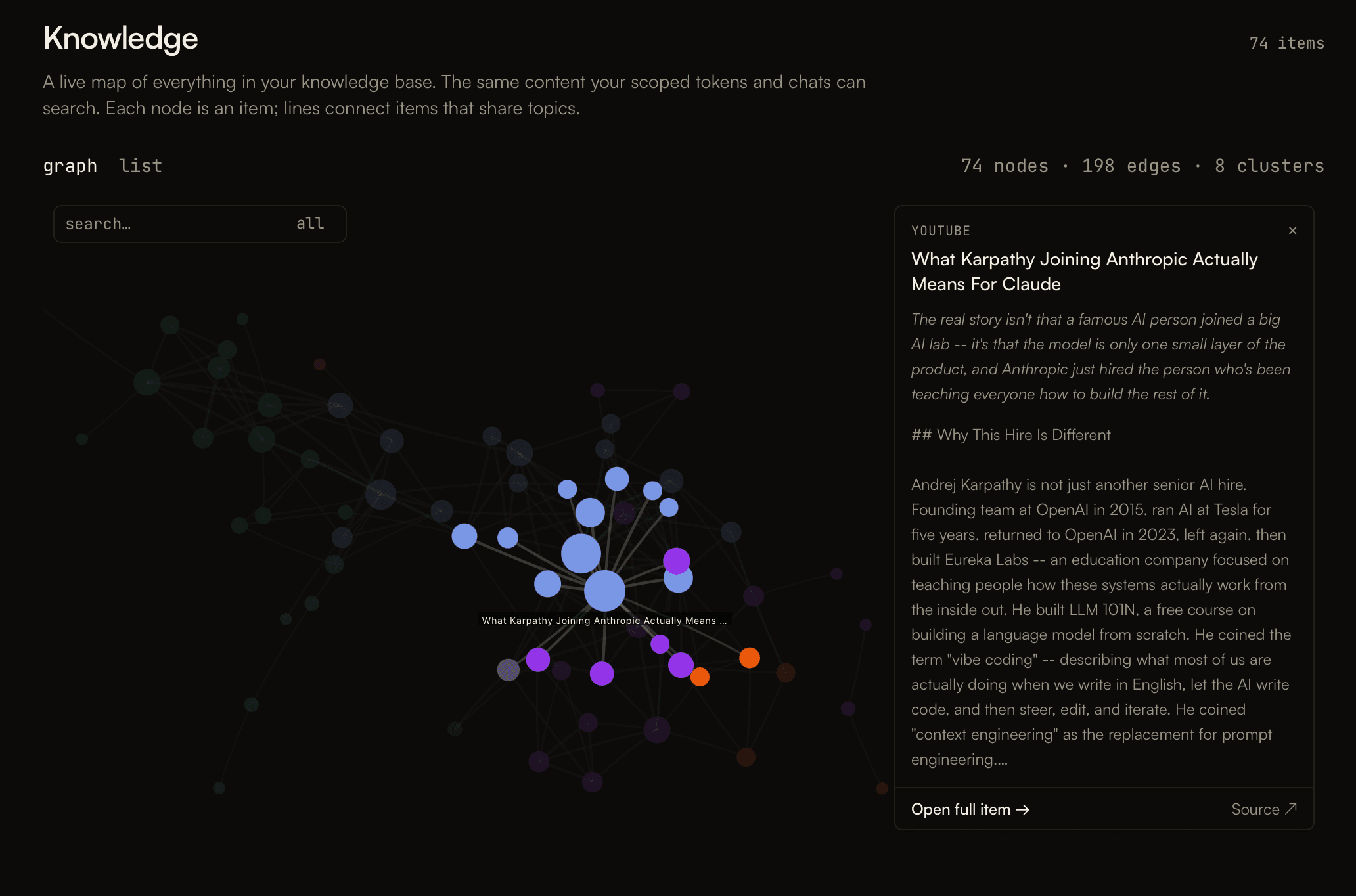
A live map of everything in your knowledge base. The same content your scoped tokens and chats can search. Each node is an item; lines connect items that share topics.

graphlist81 nodes · 148 edges · 9 clusters
Elon Musk, “In 36 months, the cheapest place to put AI is space”
21121110875
Chat

Ask anything across your knowledge base.

What are the main themes across everything I've saved?
A few clear threads run through everything you've saved.
The first is the economics of AI and labor.
Jeff Bezos argues the bottom half of earners should pay zero federal tax, and that the real problem isn't revenue but government competence.
Elon Musk, meanwhile, frames compute moving to space within thirty-six months.
Different topics on the surface, but both are really about where value and cost are about to shift, and who captures the upside.
The second thread is the economics of running AI.
Your saved piece on small models matching larger ones sits right next to Howard Marks on market cycles and the case against vertical agents.
They keep circling one question: as the cost of capable AI collapses, where does the value actually get captured, and by whom?
The third is a frustration with institutions that spend without discipline.
Bezos uses New York City schools, forty-four thousand dollars per student for worse outcomes, and that skepticism runs through your other notes too.
The throughline is competence over budget.
There's also a quieter thread about attention, that the scarce resource isn't information but the discipline to act on it.
Ask across your whole library…Web searchSend
Graniite

Bring in anything

YouTube videosPodcastsPDFsVoice memosPhotos of notesArticlesAudio filesWeb pagesYour own writing

It comes back in a form you’ll actually use.

Not one summary for everything. A talk becomes a walkthrough you can follow. A long report becomes a two-minute read. A voice memo becomes something you can revisit.

A saved article opened in Graniite: a short summary, then a clear read of what happened, with source and export controls.

Every format

Video, audio, PDF, a photo of a page, your own voice. All of it lands in one place.

Understood

Not saved and forgotten. Turned into a form you can actually read, follow, and revisit.

Connected

Linked to everything related the moment it arrives, so your library builds itself.

The Graniite knowledge graph: a live map of everything you have saved, with related items linked into clusters on their own.

Talk to one thing. Or your whole library.

Ask a single item, or everything at once. The answer reasons over what you actually saved, and shows you where it came from.

Three saves touch it. The clearest is Karpathy’s framing: it replaces prompt engineering, and it’s where you noted the real product work now lives.
Karpathy on context engineeringVoice memo, Tue
Ask across everything you’ve saved…Send

And it travels with you.

Point any folder at the AI tools you already use, with a scoped key that reads just that slice of your library. Your knowledge shows up where you work.

lev_a1c9·····scopedfolder: Marathon training
ClaudeCursorChatGPTn8n

Other tools connect your work.
Graniite connects your life.

Common questions

The things people ask before signing up.

What can I put into Graniite?

YouTube videos, podcasts, articles, web pages, PDFs, photos of notes, voice memos, and your own writing. Anything with audio or video gets transcribed automatically. If we can read it, it goes into your library.

What do I actually get back?

Not one summary for everything. Graniite matches the format to the source: a talk becomes a walkthrough you can follow, a long report becomes a two-minute read, a voice memo becomes something you can revisit. The original is always one click away.

Can I really talk to everything I've saved?

Yes. Ask a single item, or your whole library at once. The answer reasons over what you actually saved and shows you where it came from. And every item links to what it relates to on its own, so your library turns into a map of how your interests connect instead of a pile you forget.

Can I use it with the AI tools I already use?

Yes, on Core and up. Point a folder at Claude, Cursor, or ChatGPT and they can read just that slice of your library, so your knowledge shows up where you already work.

Can I export what I save?

Yes. Every item exports as markdown, plain text, or PDF, with the source preserved. Take it to Obsidian, Notion, or anywhere else you keep notes. Your library is yours.

What about privacy?

Your library is private to you. We don't train any models on your content, and you can delete anything, or your whole account, at any time. Full details are in our privacy policy.

What does it cost?

There's a free plan, no credit card required: save anything and adapt the items that matter. Paid plans start at $12 a month for more adaptive summaries, more transcription, and connecting your AI tools. See the pricing page for the details.

It becomes where things go.

The point isn’t storage. It’s that the next time something matters, you’ll already know what to do with it: put it in Graniite.

Graniite: a living map of your life